


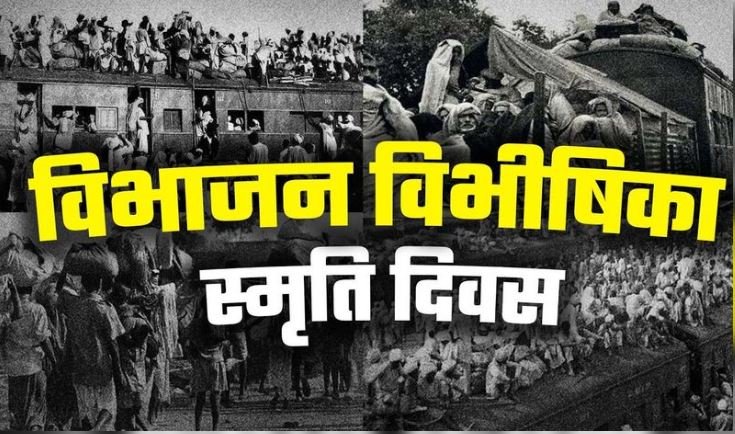
Vibhajan Vibhishika
Gaurav Gupta
“Some wounds are never visible. They are carried silently across generations.”
Every year on 14 August, India observes Vibhajan Vibhishika Smriti Diwas to remember the horrors of Partition in 1947-one of the devastating human tragedies of the twentieth century. It is a day to honour the millions who lost their homes, families, livelihoods and futures in the violence that accompanied the creation of Pakistan.
Partition did not create India. India is an ancient civilisation that continued as an independent nation in 1947. What Partition created was Pakistan-at an unimaginable human cost. The lines drawn on a map divided territories, but they also tore apart families, communities and centuries-old civilisations.
A civilisation uprooted
Before Partition, the regions that now constitute West Pakistan-including Lahore, Rawalpindi, Sialkot, Gujranwala, Lyallpur-now Faisalabad-Multan, Sheikhupura, Montgomery-now Sahiwal-Gujrat, Jhang, Dera Ghazi Khan, Karachi, Hyderabad, Sukkur, Jacobabad and countless towns and villages-were home to thriving Hindu and Sikh communities.
They were farmers, traders, teachers, artisans, industrialists, soldiers, doctors, lawyers and public servants. Their temples, gurdwaras, schools, marketplaces and homes reflected centuries of civilisational continuity. They were not temporary residents of those lands. They belonged to those towns and villages through generations of ancestry, labour and memory.
Then came Partition.
Within a short period, villages that had existed peacefully for generations were engulfed by communal violence. Homes, shops, temples and gurdwaras were looted, desecrated and destroyed. Families were attacked, separated and forced to flee. Women were subjected to abduction, sexual violence, forced conversion and forced marriage. Trains and refugee caravans became targets of mass violence, and countless people never reached safety.
In Jammu and Kashmir and adjoining regions, Hindu and Sikh communities faced brutal attacks by armed tribal raiders, Pakistani military personnel and groups operating with support from Pakistan. Areas such as Mirpur, Muzaffarabad and parts of Poonch witnessed killings, abductions, captivity, sexual violence and the destruction of entire settlements. Survivor accounts describe men being separated from their families, women and girls being abducted, and communities being driven from their ancestral lands. The precise figures remain contested, but the scale of suffering and forced displacement is beyond dispute.
The violence was not merely a spontaneous breakdown of law and order. In several areas, armed groups and Pakistani forces played a direct or enabling role in attacks on civilians. The result was the terrorisation of non-Muslim populations, the seizure of their homes and property, and the permanent uprooting of communities that had lived there for generations.
For those who survived, the greatest loss was not only material wealth. It was the loss of their mool gaon-their ancestral village.
They left behind the soil where generations of their families had lived, the fields they cultivated, the festivals they celebrated, the wells from which they drew water and the memories that had shaped their identity. They crossed into India with little more than the clothes they wore and the hope that somewhere, somehow, they might begin again.
Everything changed.
Their language and cultural surroundings gradually changed. Their traditions adapted to new circumstances. Their rehan-sehan, occupations and social networks were transformed. Yet the memory of the ancestral home remained alive-in family stories, old photographs, recipes, songs, surnames and the names of villages that many descendants have never been able to visit.
Only a displaced person truly understands the pain of displacement.
A migration without closure
Approximately 14 to 15 million people were displaced during Partition, making it one of the largest forced migrations in human history. Behind every statistic was a family, a lifetime of memories and a home left behind forever.
A significant number of these refugees settled in the Jammu region, particularly in Ranbir Singh Pura, Suchetgarh, Bishnah, Akhnoor, Samba, Hiranagar, Kathua and adjoining border areas. They cleared difficult terrain, cultivated barren land, established businesses, educated their children and contributed to agriculture, trade, public service and national defence.
But for the West Pakistan Refugees who settled in the erstwhile State of Jammu and Kashmir, Partition did not end in 1947.
They were citizens of India, but under the constitutional and legal framework that prevailed in the former state, they were not recognised as permanent residents of Jammu and Kashmir. Consequently, they could vote in elections to the Indian Parliament but were denied the right to vote in the former State Assembly and local-body elections. They also faced restrictions concerning state government employment, professional and technical education, land ownership and other opportunities linked to permanent-resident status.
Thus, they were Indians-but, for decades, they were treated as outsiders in the very part of India where they had rebuilt their lives.
Their children and grandchildren inherited the consequences. A family could live in Jammu for generations and still find that its members could not fully participate in the political, economic and educational life of the state. A displacement caused by Partition became a condition of incomplete belonging.
Violence beyond the border
The suffering of these families also continued through insecurity.
Many were settled in villages close to the International Border, where Pakistani shelling and ceasefire violations repeatedly damaged homes, destroyed crops, killed livestock and disrupted education. In sectors including R.S. Pura, Arnia, Suchetgarh, Samba and Kathua, border residents have repeatedly been forced to leave their homes temporarily because of cross-border firing. For families that had already been uprooted once, the sound of mortar fire revived the trauma of 1947.
The rise of terrorism and separatism in Jammu and Kashmir added another layer of fear. Separatists and extremist organisations threatened civilians, political workers, minorities and families who refused to support their agenda. Their violence was often accompanied by propaganda rejecting India’s constitutional order and promoting separation or merger with Pakistan.
This distinction must be made clearly: responsibility for such crimes lies with terrorist organisations, separatist networks, extremist leaders and their sponsors-not with Kashmiri Muslims as a whole. Ordinary Kashmiri Muslims also suffered greatly at the hands of terrorists. The real enemy was, and remains, the ideology of violence, religious extremism, separatism and political discrimination.
For West Pakistan Refugees, the injustice after their arrival in India therefore had two dimensions. They faced life on a vulnerable border and the continuing threat of Pakistan-sponsored violence, while also suffering decades of exclusion under the former state’s legal and political system.
A constitutional turning point
The constitutional changes of August 2019, which reorganised the former State of Jammu and Kashmir and removed the separate constitutional provisions associated with Articles 370 and 35A, marked a historic turning point. The Govt. of India stated that the Constitution of India would now apply fully to Jammu and Kashmir and Ladakh.
Following these changes and subsequent domicile and administrative measures, West Pakistan Refugee families became eligible for rights and opportunities that had earlier remained unavailable to them, subject to applicable legal requirements. These included participation in Assembly and local-body elections, access to Union Territory employment and greater legal security concerning property and residence.
The subsequent grant of proprietary rights over certain state lands allotted to refugee families further strengthened their sense of legal and economic security.
For them, this was not merely an administrative reform. It was the closing of a constitutional chapter that had begun in 1947.
From displacement to dignity
The West Pakistan Refugees who arrived with empty hands refused to remain victims forever. They rebuilt their lives through hard work, discipline and dignity. They turned difficult land into productive farms, established markets and institutions, educated their children and served India in the armed forces, administration, business, agriculture and every other sphere of national life.
They lost their villages but not their values.
They lost their homes but not their hope.
They lost their past but helped build India’s future.
As India enters its 80th year of Independence, it is also approaching eight decades since millions were uprooted from their ancestral homes. The generation that witnessed Partition is slowly disappearing. With it, the living memory of villages, streets and families that no longer exist in the same form is also at risk of fading.
Remembering Vibhajan Vibhishika is not about nurturing hatred or reopening old wounds. It is about acknowledging historical truth, honouring those who suffered, recognising the injustice that prolonged their hardship and learning the cost of communal hatred, separatism and political discrimination.
The story of the West Pakistan Refugees is not merely a story of migration. It is a story of survival, resilience and faith in India. They lost their villages but not their values; they lost their homes but not their hope; and they endured decades of unequal treatment without abandoning their democratic faith.
The constitutional changes of recent years did not erase the pain of Partition, but they helped correct a historic injustice. They affirmed a simple principle: no Indian citizen should remain permanently excluded from equal rights in any part of India.
Their ancestors rest across the border. Their memories remain rooted in lands they may never see again. Their future, however, was built on Indian soil. Their sacrifice deserves remembrance. Their perseverance deserves respect. Their long struggle for equality deserves a permanent place in India’s national memory.
(The author is BJP Spokesperson & Convenor International Affairs J&K UT)